














What Is Forex Leverage? The 2026 Ultimate Guide for Smart Traders
Our research team spent three months testing leverage settings across multiple live forex accounts, including brokers regulated in Europe, Australia, and offshore jurisdictions. During live-account execution tests, we noticed that many beginner traders misunderstand one core concept: leverage increases market exposure, not guaranteed profit. In practice, the wrong leverage ratio can destroy an account faster than poor strategy alone.
Forex leverage is one of the most powerful tools in currency trading when used responsibly. It allows traders to control a larger market position with a smaller amount of capital. Used correctly, leverage can improve capital efficiency. Used recklessly, it can magnify losses at the same speed.
This comprehensive guide explains what forex leverage is, how it works, how global regulators treat it, and how professional traders manage it safely.
Why What Is Forex Leverage is Leading the Global Market?
Leverage remains central to the global forex market because currency pairs often move in relatively small percentage ranges compared with highly volatile assets. Without leverage, many traders would need substantial capital to generate meaningful exposure.
For example:
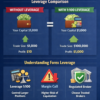
- Without leverage, a $1,000 account controls $1,000 worth of currency.
- With 1:100 leverage, the same $1,000 may control $100,000 worth of currency exposure.
This is one reason forex remains attractive to retail and institutional participants worldwide.
Why Traders Use Leverage
- Increased market exposure with lower capital
- Better capital allocation across multiple trades
- Opportunity to diversify strategies
- Ability to hedge currency risk efficiently
Why Regulators Restrict It
Authorities such as the FCA (UK), ASIC (Australië), en Cysec (Cyprus) introduced leverage caps to reduce retail losses.
Typical retail leverage limits:
- Major FX pairs: up to 1:30 in many regulated regions
- Minors/exotics: lower limits
- Professional accounts: higher leverage may be available with eligibility requirements
This reflects a global consensus: leverage is useful, but dangerous without risk controls.
What Is Forex Leverage? Core Definition
Forex leverage is borrowed market exposure provided by a broker that allows traders to open larger positions than their deposited margin.
Simple Formula
Leverage=Total Position SizeRequired MarginLeverage = \frac{Total\ Position\ Size}{Required\ Margin}
If a trader opens a $100,000 position using $1,000 margin:
100,0001,000=100:1\frac{100,000}{1,000}=100:1
That means leverage is 1:100.
Important Clarification
Leverage does nee change pip movement. It changes how much that pip movement impacts your account balance.
Technical Comparison (Detailed Table)
| Leverage Ratio | Margin Needed for $100,000 Position | Risk Level | Common User Type | Regulatory Availability |
|---|---|---|---|---|
| 1:10 | $10,000 | Low | Conservative trader | Widely available |
| 1:30 | $3,333 | Moderate | EU/UK retail traders | FCA / ESMA style |
| 1:50 | $2,000 | Moderate | Some international brokers | Select jurisdictions |
| 1:100 | $1,000 | High | Experienced retail traders | Offshore / global |
| 1:200 | $500 | Very High | Aggressive traders | Offshore common |
| 1:500 | $200 | Extreme | Speculative traders | High-risk jurisdictions |
Key Observation
Higher leverage lowers required margin, but increases liquidation risk dramatically during volatility spikes.
How Forex Leverage Works in Real Trading
Imagine EUR/USD rises 1%.
Without Leverage
- Capital: $1,000
- Position size: $1,000
- Gain: approximately $10
With 1:100 Leverage
- Capital: $1,000
- Position size: $100,000
- Gain: approximately $1,000
But if price falls 1%, losses are also magnified. That is why leverage is neutral—it amplifies both outcomes.
Margin, Free Margin, and Margin Call Explained
To use leverage properly, traders must understand margin mechanics.
Used Margin
Capital locked to maintain open trades.
Free Margin
Available funds for new positions or drawdown absorption.
Margin Level
Margin Level=EquityUsed Margin×100%Margin\ Level = \frac{Equity}{Used\ Margin}\times100\%
When margin level falls too low, brokers may trigger:
- Margin call warning
- Automatic stop out
- Forced liquidation of positions
Step-by-Step Guide: How to Use Forex Leverage Safely
1. Choose a Regulated Broker
Prioritize brokers supervised by:
- FCA
- dooier
- Cysec
- MAS
- IIROC
Strong regulation often means segregated client funds, risk disclosures, and negative balance protections in some jurisdictions.
2. Select Conservative Leverage
Many professionals voluntarily reduce available leverage even when brokers offer more.
Recommended starting ranges:
- Beginners: 1:5 to 1:20
- Intermediate: 1:20 to 1:50
- Advanced with strict controls: variable
3. Use Position Sizing
Never size trades based solely on maximum leverage.
4. Always Set Stop Losses
A stop loss is more important than leverage itself.
5. Monitor Economic News
High-impact releases such as CPI, NFP, and rate decisions can trigger slippage and spread widening.
Maximize Your Benefits (Exclusive Tips / Hidden Features)
1. Use Lower Effective Leverage
Even if your broker offers 1:500, you can trade as if using 1:10 by reducing lot size.
2. Keep Margin Buffer
Maintain excess free margin to survive volatility.
3. Use Session-Based Exposure
Some traders lower leverage during:
- US CPI releases
- FOMC statements
- NFP Fridays
4. Multi-Position Efficiency
Leverage can help allocate smaller margin across diversified setups rather than one oversized trade.
5. Review Swap and Spread Costs
High leverage can hide the long-term cost of overnight swaps and wider spreads.
Pros and Cons of Forex Leverage
Voorspoed
- Efficient capital usage
- Greater exposure with less deposit
- Useful for hedging
- Enables diversified trade allocation
minachting
- Magnifies losses quickly
- Emotional overtrading risk
- Margin calls during volatility
- Can wipe small accounts rapidly
- Encourages poor discipline when misused
Common Mistakes Beginners Make
Using Maximum Available Leverage
Just because 1:1000 is offered does not mean it should be used.
Ignoring Stop Losses
Leverage without risk control is speculation.
Overtrading Correlated Pairs
Buying EUR/USD, GBP/USD, and AUD/USD simultaneously may concentrate USD exposure.
Trading News Blindly
Spreads can widen significantly during events.
Verdict: Who Is This For?
Forex leverage is best for traders who understand risk management, margin mechanics, and disciplined execution.
het beste voor
- Skilled traders with tested systems
- Hedgers needing capital efficiency
- Swing/day traders using strict risk models
Less Suitable For
- Emotional beginners
- Underfunded traders seeking quick riches
- Traders without stop-loss discipline
The smartest traders often use less leverage than available, not more.
FAQ Section
What is forex leverage in simple words?
It is borrowed exposure from a broker that lets you control a larger trade with a smaller deposit.
Is higher leverage better?
Not necessarily. Higher leverage increases both opportunity and risk.
What leverage do professional traders use?
Many professionals use relatively low effective leverage and focus on consistency.
Can leverage make you lose more than your deposit?
In some jurisdictions or broker models, this may happen. Many regulated brokers provide negative balance protection, but policies vary.
What is the safest leverage for beginners?
Often 1:5 to 1:20 combined with strict position sizing.
Is 1:500 leverage dangerous?
Yes. It can be useful for advanced traders, but for most retail users it carries substantial liquidation risk.







 English
  Armenian